
Understanding how children grow and develop is like trying to solve a delightful puzzle that keeps changing shape. Theories of child development offer fascinating insights into this journey, helping parents, educators, and curious minds grasp the intricate processes behind a child’s growth. From Freud’s eyebrow-raising ideas to Piaget’s mind-bending stages, these theories reveal the hidden gears that drive a child’s learning and behavior.
Overview of Theories of Child Development
Child development theories explore how children grow and learn at different stages. These frameworks offer insights into emotional, cognitive, and social development. Key theories include Sigmund Freud’s psychosexual stages and Jean Piaget’s cognitive development stages.
Freud’s theory emphasizes the influence of early experiences on personality. He proposed that children progress through five stages: oral, anal, phallic, latency, and genital. Each stage contributes to personality formation, defining future behavioral patterns.
Piaget’s theory focuses on cognitive development, describing how children perceive and interact with the world. His model outlines four stages: sensorimotor, preoperational, concrete operational, and formal operational. Each stage represents a distinct way of thinking and understanding, ranging from basic interactions to abstract reasoning.
Lev Vygotsky introduced a sociocultural perspective, highlighting the role of social interaction in learning. Vygotsky argued that children learn through guided interactions with more knowledgeable individuals. This theory underscores the importance of culture and language in cognitive development.
Erik Erikson expanded on Freud’s work with his psychosocial development theory, comprising eight stages. Each stage presents a conflict that impacts personality and social relationships, from trust versus mistrust in infancy to integrity versus despair in later life.
These theories collectively enrich understanding of child development. They emphasize various aspects, from emotional experiences to cognitive processes and social influences. Recognizing these theories aids parents and educators in fostering environments conducive to healthy development.
Cognitive Development Theories
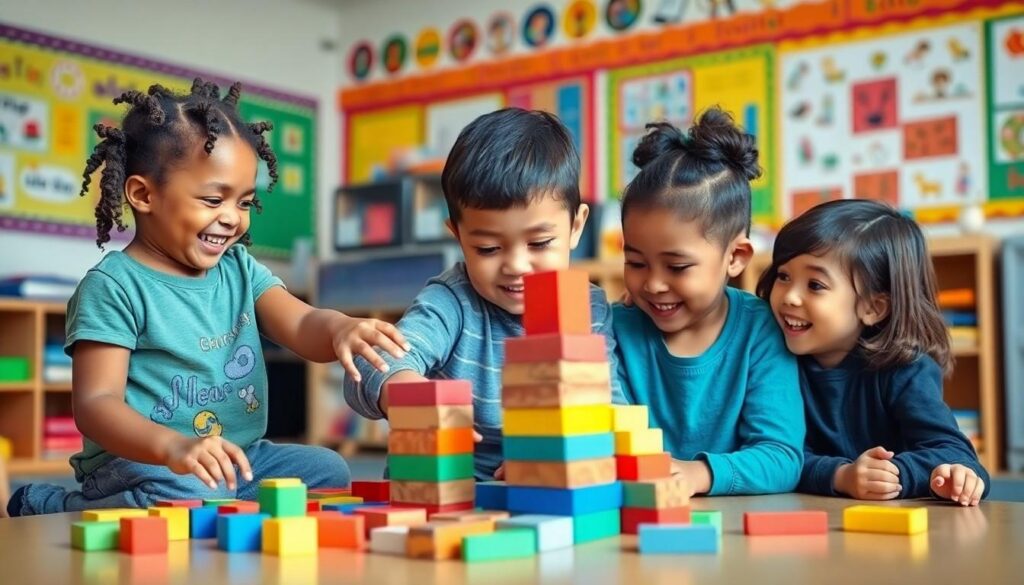
Cognitive development theories explain how children think and learn. Two influential theories come from Jean Piaget and Lev Vygotsky.
Piaget’s Stages of Development
Piaget’s theory consists of four stages: sensorimotor, preoperational, concrete operational, and formal operational. Each stage represents distinct cognitive abilities. During the sensorimotor stage, infants explore their environment through senses and actions. The preoperational stage allows children to engage in symbolic play but struggle with logic. In the concrete operational stage, children develop logical thought and understand concrete concepts. Finally, the formal operational stage introduces abstract thinking and problem-solving. Piaget emphasized that children progress through these stages sequentially, highlighting the importance of readiness for learning.
Vygotsky’s Sociocultural Theory
Vygotsky’s sociocultural theory focuses on the role of social interaction and culture in cognitive development. He introduced concepts such as the zone of proximal development (ZPD) and scaffolding. The ZPD identifies the difference between what a child can do independently and what they can achieve with guidance. Scaffolding involves providing support and gradually withdrawing it as the child becomes more competent. Vygotsky argued that learning occurs through dialogue and collaboration, emphasizing the significance of cultural tools and language in shaping thought processes. This theory underscores that cognitive development is inherently social and contextual.
Psychosocial Development Theories
Psychosocial development theories explore the emotional and social dimensions of child growth. Among these, Erikson’s eight stages and attachment theory play crucial roles in understanding personality and relationships.
Erikson’s Eight Stages
Erik Erikson proposed eight stages of psychosocial development that span from infancy to adulthood. Each stage presents a unique conflict that individuals must resolve to develop a healthy personality. For example, during infancy, trust versus mistrust influences emotional security. Similarly, adolescents face identity versus role confusion, impacting their sense of self. Successful resolution of these conflicts strengthens interpersonal skills and fosters a positive self-image. Failure to navigate these stages can lead to challenges in relationships and personal development later in life.
Attachment Theory
Attachment theory, developed by John Bowlby, emphasizes the importance of early emotional bonds between children and caregivers. Secure attachment fosters trust and emotional regulation. In contrast, insecure attachment may lead to anxiety and difficulties in relationships. A child’s experience with caregivers affects their ability to form relationships throughout life. For instance, children with secure attachments tend to demonstrate better social skills and resilience. Understanding these attachment styles allows parents and educators to create supportive environments that promote positive interactions and overall well-being.
Behavioral and Social Learning Theories
Behavioral and social learning theories provide insight into how children develop behaviors and social skills. These theories emphasize the role of environmental factors in shaping a child’s understanding of the world.
Skinner’s Operant Conditioning
Skinner’s operant conditioning highlights the importance of reinforcement and punishment in behavior development. Positive reinforcement encourages desired behaviors through rewards, while negative reinforcement removes unfavorable outcomes. For example, a child receiving praise for completing homework increases the likelihood of that behavior. Conversely, punishment aims to reduce undesirable actions, such as reprimanding a child for misbehavior. This practical approach underscores that consistent application of rewards and consequences significantly influences learning processes.
Bandura’s Social Learning Theory
Bandura’s social learning theory emphasizes learning through observation and imitation. Children often mirror behaviors exhibited by role models, such as parents, peers, or media figures. For instance, a child who sees a sibling sharing toys may imitate that behavior, leading to social interaction skills. Additionally, Bandura identified the role of cognitive processes in learning; children must recognize and interpret modeled behaviors before they can replicate them. By understanding the dynamics of observational learning, parents and educators can actively foster positive behaviors in children.
Contemporary Perspectives
Contemporary theories provide valuable insights into child development, integrating various factors that influence a child’s growth.
Ecological Systems Theory
Ecological Systems Theory, developed by Urie Bronfenbrenner, emphasizes the interconnectedness of various environmental systems in a child’s life. This theory categorizes environmental influences into four systems: microsystem, mesosystem, exosystem, and macrosystem. The microsystem includes immediate relationships and experiences, such as those with family and peers. The mesosystem consists of interactions between different microsystems, while the exosystem encompasses broader community influences. Lastly, the macrosystem reflects larger societal and cultural contexts. Understanding these interactions helps caregivers create a supportive environment that promotes optimal development.
Information Processing Theory
Information Processing Theory likens the human mind to a computer, focusing on how children encode, store, and retrieve information. This theory examines cognitive processes, including attention, memory, and problem-solving skills. By analyzing how children process information, educators can develop strategies to enhance learning. For instance, breaking tasks into smaller components aids comprehension and retention. Cognitive load theory highlights the importance of managing the amount of information presented at once. Such insights assist parents and educators in tailoring their approaches to foster better understanding and support cognitive development effectively.
Understanding the various theories of child development is essential for anyone involved in nurturing young minds. Each theory offers unique perspectives that illuminate the complex interplay of emotional, cognitive, and social factors in a child’s growth. By integrating insights from Freud, Piaget, Vygotsky, Erikson, and others, parents and educators can create supportive environments tailored to children’s needs.
These theories not only clarify developmental stages but also highlight the importance of relationships and cultural contexts. This knowledge empowers caregivers to foster healthy development and positive behaviors, ultimately shaping well-rounded individuals. Embracing these principles can lead to more effective strategies in guiding children through their formative years.